
Boondi laddu is a beloved Indian sweet that graces many festive occasions, from Diwali to weddings. These round, golden delights are made from small, crispy droplets of chickpea flour batter, which are then soaked in sugar syrup and formed into laddus. Here’s a detailed recipe to help you make boondi laddu at home.
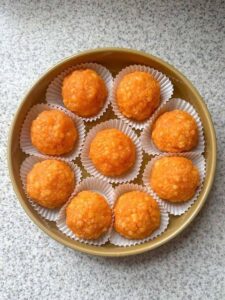
Ingredients
For the Boondi:
- 1 cup chickpea flour (besan)
- 1/2 cup water (adjust as needed for batter consistency)
- A pinch of baking soda
- A pinch of saffron color (optional)
- Oil or ghee for deep frying
For the Sugar Syrup:
- 1 cup sugar
- 1/2 cup water
- 1/4 teaspoon cardamom powder
- A few saffron strands (optional)
- 1 teaspoon rose water (optional)
For Garnish:
- 2 tablespoons chopped nuts (almonds, pistachios, or cashews)
- 1 tablespoon raisins (optional)
Instructions
Step 1: Prepare the Boondi Batter
- In a mixing bowl, combine the chickpea flour, baking soda, and saffron color.
- Gradually add water, whisking continuously, until you achieve a smooth, lump-free batter with a slightly thick, pourable consistency.
Step 2: Fry the Boondi
- Heat oil or ghee in a deep frying pan over medium heat.
- To check if the oil is ready, drop a small amount of batter into the oil. It should rise to the surface immediately without turning too dark.
- Hold a perforated ladle (boondi ladle or jhara) over the hot oil and pour a small amount of batter onto the ladle.
- Gently tap the ladle or move it in circular motions to allow the batter to fall through the holes into the hot oil, forming small droplets.
- Fry the boondi until they are crisp but not browned. Remove with a slotted spoon and drain on paper towels. Repeat with the remaining batter.
Step 3: Prepare the Sugar Syrup
- In a saucepan, combine the sugar and water. Cook over medium heat, stirring occasionally, until the sugar dissolves.
- Increase the heat and bring the mixture to a boil. Cook until it reaches a one-string consistency (when a drop of syrup between your fingers forms a single string).
- Add the cardamom powder, saffron strands, and rose water. Stir well and remove from heat.
Step 4: Combine Boondi and Sugar Syrup
- Place the fried boondi in a large mixing bowl.
- Pour the hot sugar syrup over the boondi, ensuring they are fully submerged.
- Add the chopped nuts and raisins (if using).
- Mix well to coat all the boondi with the syrup. Let it rest for 5-10 minutes so the boondi absorbs the syrup.
Step 5: Form the Laddus
- While the mixture is still warm, grease your hands with a little ghee.
- Take a small portion of the boondi mixture and press it firmly between your palms to form round laddus.
- Repeat with the remaining mixture to make all the laddus.
- Allow the laddus to cool completely at room temperature.
Tips for Perfect Boondi Laddu
- Ensure the boondi batter is of the right consistency; too thin and the boondi will be flat, too thick and they will be dense.
- Fry the boondi over medium heat to ensure they cook evenly and remain crisp.
- Make sure the sugar syrup is at one-string consistency for the perfect sweetness and texture.
- Work quickly when shaping the laddus as they are easier to form when warm.
Conclusion
Boondi laddu, with its melt-in-the-mouth texture and delightful sweetness, is a treat that embodies the festive spirit of Indian celebrations. Follow this recipe to create these delicious laddus at home and bring a touch of traditional sweetness to your festivities. Enjoy!

The creator behind this blog, and I’m thrilled to share my passion for vegetarian cooking with you.
Cooking has always been a joyful journey for me, filled with vibrant flavors, wholesome ingredients, and the creativity that comes with crafting delicious meals.
Growing up in a family where food was at the heart of every celebration, I learned the art of cooking from my mother and grandmother. Their recipes, steeped in tradition and love, inspired me to explore and experiment in the kitchen. Over the years, I’ve developed my own unique style, blending traditional and contemporary flavors to create vegetarian dishes that are both nutritious and delightful.